Tuesday, April 3, 2007

The UN Refugee Agency


Tonight I don’t want to discuss too much about the UN Refugee Agency, because I think the website has something greater to offer. The title is pretty self-explanatory. The organization has been helping refugees worldwide since the 1950’s. The websites is one of the most modern I have seen. There are great links throughout the site to stories and up-to-date information. There is also a section that lists areas of major operations. There is a link dedicated to Chad/ Darfur. I think this shows how on top of the situation they are.

Anyway, what I wanted to demonstrate tonight, was the photo albums the section has to show. They are listed below. “A picture is worth a 1000 words…”

Internally Displaced in Chad: Violence Crosses the Border

Camp Life in Eastern Chad

Portrait’s of Darfur’s refugees (This is my favorite, the faces show much character!)

Destruction and Displacement in Darfur, Sudan

The Environment in Chad

Chad: relocation from the border to refugee camps

Monday, April 2, 2007

The Connection Between the Mid-West and Darfur..


Today I am again putting off talking about more of Ann Curry’s links. I wanted to discuss a story my aunt Lisa had sent me. I didn’t have a link to the story so I wanted to briefly summarize it.

The photos to the left are from an advertisement done by the Save Darfur organization I have frequently discussed. The ad was in the January 25 edition of Rolling Stone. I was impressed to see that it was a full-page ad.

Anyway, back to the story. The story by Susan Saulny is titled,
”After Darfur, Starting Anew in the Midwest.”

Apparently Fort Wayne, Indiana, among other Indiana cities is home to as many as 300 people from Darfur. There is an organization called Darfur Peace and Development in Fort Wayne. It is a nonprofit organization

The first Darfuri families came in the early 90’s. There are many industrial jobs in the area. There are also many other diverse groups. The city’s population is 250,000 and 77 languages are spoken at the public school. They still face problems of misunderstood cultural practices, as imagined. But the article said most feel generally welcome.

Many people in the community are becoming activists for Darfur as well.

Fawzia Suilman is a 24-year old woman discussed in the story. She is from the Darfur region and had her home burned to the ground by the janjaweed militia in the summer of 2005. Many of her family members were killed. In the article she says, “I cry every day about how my family died.”
She has a 1-year-old son Zakaria, but lost her husband in the chaos of 2005.

Someone at a refugee camp in Chad told Suilman about Indiana and his cousin that she should get in touch with if she were to go there.

One of the things I found most touching was this quote from Suilman, “I keep the pictures of my family on my refrigerator to remember when we could not eat. It makes me sick. I do not like to remember.”

I thought this story was very shocking. Of all places I could not imagine that people from Darfur would go to Indiana. But it was nice to hear that they were so welcomed. I could not imagine how hard it was for Suilman to adjust. America is clearly very different than her home. I think one of the hardest things, well maybe not in this specific community, would be remembering your family and hoping your husband was alive, while you are in America where those problems seem so far away to the rest of this nation.

Sunday, April 1, 2007

Movie Stars Getting Involved

Sunday evening is not a very pleasant time for me. I usually am just starting to do my work. Today, however, I got to visit my grandparents so it’s hard for me to be annoyed this weekend. My grandfather, who besides professor Matson, is one of my only dedicated blog readers. He had saved a few articles for me that followed up on something I had discussed before. Angelina Jolie and her presence in Africa. While I don’t want to give more attention to movie stars than they already get, I liked what Jolie said in the article.

There was recently a short article with a series of black and white impacting photos (pictured below) in Newsweek magazine from Jolie’s visit to a refugee camp on the border of Darfur and Chad. The article starts out discussing how Jolie is a very easily recognizable person.


She says, “If I can draw you in a little because I’m familiar, then that’s great…because I know that at the end you’re not looking at me, you’re looking at them.”


There is fighting very close to this camp and it is in a fairy dangerous area where everyone, including aid workers and Jolie when she was there had to be cautious of their lives. The article also discusses how Jolie got involved and educated 6 years ago before the press even recognized her for doing so. Jolie and the article both made mention of the impact of pictures. Which is why I really liked this article. It didn’t focus entirely on Jolie and made mention of the people and the importance of spending time with them and SEEING their story.

The picture below was heart breaking, especially after hearing the story of the child and Jolie’s experience with him.

Jolie is holding a 7-year old boy who has to remain “tethered” in the camp because he has a mental disability and they do not want him to wonder away.

“According to aid workers, he saw his village bombed when he was 3 and hid alone in the bush for two days before his family found him and fled across the border.”

To see more pictures and a video you can visit the Newsweek website to see this package.

My grandfather also gave me a proto-type letter from Paul Newman who is also active in supporting refugees. Thought I should make mention of him as well. In his letter he says:

“I ask you to join me in supporting the International Rescue Committee, which focuses exclusively on providing refugees worldwide with life-saving, hope-giving assistance.”

He makes mention specifically of the refugees in Darfur with a brief history and statistical update of the displaced. He then discusses the IRC and the work they are doing. He asks in his letter to donate to the IRC. With mention of their website.

He points out that the IRC gives more than 90 cents of every dollar donated directly to refuges.


Thursday, March 29, 2007

Human Rights Watch


The Human Rights Watch is another organization that is dedicated to poverty-stricken countries worldwide.

“Human Rights Watch is dedicated to protecting the human rights of people around the world.
We stand with victims and activists to prevent discrimination, to uphold political freedom, to protect people from inhumane conduct in wartime, and to bring offenders to justice.
We investigate and expose human rights violations and hold abusers accountable.
We challenge governments and those who hold power to end abusive practices and respect international human rights law.
We enlist the public and the international community to support the cause of human rights for all.”

There is a section that goes into more detail to describe who what where when why and how they help.

They have many programs in Africa including dedicated efforts to Darfur. The Africa home page has a list of briefing papers and publications that discuss stories about Africa. Many are on Darfur.

The actual “Darfur in Crisis” page is very informative. It’s made up of current stories specifically about Darfur. There are also a list of links along the side of the page including a background section with a map and a Q & A page, how you can help and recent reports from the area.

The Q & A section is very informative and covers a lot of the basic questions people may have about Darfur.

There is also a part about what you can do in Darfur. Well worth checking out. Most of the things do not involve donating money but helping to take action. There are detailed descriptions for all of the easy steps listed below:

“Inform yourself about Darfur
Write to your local newspaper
Hold a video screening
Write to the Members of the UN Security Council (addresses below)”

There are many issues that they encourage you to discus in your letter to the UN.
There is also the ability to see if you were living in the United Kingdom what you could do to help.

Wednesday, March 28, 2007

Genocide Intervention Network article


For today I want to talk about a specific area on the genocide intervention network website. First off I would like to say that immediately after I posted Ann Curry’s recommended links, they immediately posted a comment letting me know that they’d be willing to answer any questions I had.

There is so much information offered through the website. I am going to try to come back to it and discuss more of the attributes that make this such an informative and helpful source on Darfur.

Today I wanted to discuss an article I immediately linked to after viewing the home page. The article is about Americans demanding action in Darfur. I thought this would be a good focus for the day’s blog because I have been so negative throughout my blog about America in general not being involved.

The first paragraph is as follows:
“According to a December Genocide Intervention Network poll, a majority of Americans now see ending genocide as a high foreign policy priority. Despite the predominance of Iraq and terrorism in US media and foreign policy discussions, we now have proof that strong majorities feel that the United States should take action to bring about peace in Darfur, and favor doing so in cooperation with the international community.”

I thought that summed it up the point of the article.

There is then a link to another page that discusses the poll results. The most impressive statistic I thought was that 62% of Americans believe that Darfur should be a priority. If you think about it in numbers, that’s almost two times our president’s approval rating.

Also, 80% of Americans, or 4 out of 5, feel that educating students on genocide is mandatory.

These results are very impressive and I urge anyone who takes the time to read this to get all the statistical data off the poll results link mentioned above. Hopefully the numbers can soon mean more than just percentages and have more and more voices to speak them to the nation and the world.

Tuesday, March 27, 2007

Doctors Without Borders


Doctors without borders is another one of Ann Curry’s suggested links. Again, like many of the other organizations she has linked to, this is a very large organization that works elsewhere, but also in Sudan. Doctors without borders is “an independent international medical humanitarian organization that delivers emergency aid to people affected by armed conflict, epidemics, natural or man-made disasters, or exclusion from health care in more than 70 countries.”

Founded in 1971, the organization has only grown. They get a lot of attention from the press and participate in many public events as to bring attention and funds to their cause. Thousands of workers are assisting in countries of need.

The “About Us” page goes into more depth about how they run their program financially and in the field.

Throughout the website there are many links and many news updates as to what’s happening around the world and also what their organization is doing to help.


There is a list (picture to the left) in which anyone can go to a specific country doctors without borders is assisting in and see the kind of work being done there. Unlike the other websites however, there was also an option to “select an issue,” i.e. AIDS/HIV.

The page for Sudan had recent news and also discussed what was happening in the different areas of Darfur. They called their work there “of the most significant operations in the world for (doctors without borders)”


They discuss the decrease in international aide to the area. In Northern Darfur there has been a tremendous decrease in security and the availability to treat health issues, including the large amount of Malaria cases, is becoming more and more impossible.

The case is similar in Western Darfur. As we have discussed, the bordering area of Chad is a treacherous place to be. This page discusses the lack of medical attention and aid from other organizations but also discusses what their organization is trying to do to help.

They also discuss the work they are doing in Southern Darfur, especially in Kalma, the largest city of displaced persons, around 90,000.

This article really brought my attention to the medial care we are so easily offered and I think take for granted. While I don’t agree with the current policy of health care in the United States, I personally can’t complain. My father, a doctor, has always been able to provide us with the best of the best health care plans. I know this is not the case for all in the US, but from my point of view, we are pretty damn lucky. How many times have you heard of someone in the US having Malaria? And if someone does it’s on the national news as such a rarity. The vaccinations we have today are amazing, but when was the last time you woke up and said to yourself, “I am so glad I was vaccinated as a child!” I personally have never done it. With everything else the people of Darfur have to worry about, it saddens me even more so to find yet another thing they have to worry about that we take advantage of every day.

Monday, March 26, 2007

Ann Curry interviews with al-Bashir


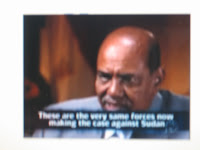
As I said yesterday, I wanted to look more into the linked articles Ann Curry did. They are actually links to two very impressive interviews she did with president al-Bashir. This web page has two videos and a written transcript of the first video. I found them to be very VERY insightful.

The first video gives a good introduction with the statistics of the murdered and displaced victims of Darfur and also lets us know that this is the first television interview done in three years with a western journalist. Way to go Curry!

After watching this video, I also feel a little guilty about being so hard on the US and their action in Darfur. Who I really should have been criticizing is the president. I found his statements horrifying and hope to God we never have a president that ignorant to what is occurring in his country. In the first video he completely denied that the atrocities that have been reporter on were in fact true. During a good portion of the interview, he related the Darfur crisis to what happened in Iraq and blamed the US for wanting to interfere for the sake of oil. (Probably not a bad accusation seeing as, in my opinion, we’ve done that before) However, I think that in this situation that comment is completely irrelevant. I believe that the US and the UN are interfering for the sake of stopping crimes against humanity.

Rather than me explaining it, here is a clip of exact words that were spoken:
“Ann Curry: Mr. President, I have this map from the U.S. Department of State that shows more than a thousand villages in the Darfur region — more than a thousand burned.
And the question is, how can this be done by Arab militias without the support of the Sudanese government? This is shocking.
Omar al-Bashir: What do you think about the picture that Colin Powell presented before the national security that confirmed and illustrated the presence of weapons of mass destruction in Iraq? What do you think about it?
Curry: You're saying this is not true?
Al-Bashir: This picture is the same fabrication and the same picture as the ones Colin Powell presented about Iraq.”

While I am not a fan of al-Bashir, I think that he makes a valid point in arguing that what Colin Powell demonstrated as locations of WMD was false so this map of burned Darfur villages is false too. While I don’t believe that is the case at all, I think that the situation in Iraq and the way our government has/is handling it has affected our credibility to other nations tremendously. This is a clear-cut example of how the war in Iraq has caused us and possibly will cause us problems down the road.

In the first video as well as the second video, the president claimed that 99% of rapes were fabrications. It is hard for me to find an ounce of respect for a man like that when there is blatant proof in the horrific stories his countries women and girls are telling.

After watching these two videos I found an even greater fondness for Ann Curry and the work she is doing. She is very lady-like, but at the same time, ballsy, for lack of a better word. She is not afraid to put big questions and her opinions on the table and she’s fighting to bring justice to the people of Darfur through the media. I admire her work and personality tremendously.

(the images to the right are pictures from the article and the interview videos)